Letter from the presidents
Honourable Delegates,
Only two weeks to go to the opening of the 15th National MEP session in Lower Austria and we, the Presidents of the General Assembly, cannot wait to welcome you all to Klosterneuburg, the 16th largest town in Austria and 3rd largest in Lower Austria after St. Pölten and Wiener Neustadt. We look forward to welcoming you heartily also to Lower Austria, the largest province in the country.
First and foremost we want to express our sincere congratulations to you for winning a place to represent your federal province at this National MEP Session!
Within four days only you will have the opportunity to engage in interesting discussions, maybe even heated debates drafting the committee resolution and to meet young people from all over Austria. Your Committee Meetings will be held in BG/BRG Int School Klosterneuburg, while the General Assembly will be held in Landhaus St.Pölten.
As your Committee Presidents are reaching out to you, you will be provided with all the necessary information concerning your committee work and your preparation. (see preparation module visit www.mepaustria.at). We kindly ask you to come prepared so you can actively and fully participate in the discussions.
You will be staying with host families in the beautiful town of Klosterneuburg, which is located very close to Vienna. The process of finding host families is almost completed and we will soon be providing you with more information.
The opening ceremony of our MEP session will be held in Augustinussaal of Klosterneuburg Monastery, the committee meetings will be held at BG BRG Int School Klosterneuburg. Moreover, we are proud to announce that we will be meeting the former Vice-President of the European Parliament and current MEP Mag. Othmar Karas, the current Vice-President of the European Parliament and MEP Mag. Ulrike Lunacek, the Town Mayor of Klosterneuburg Mr Stefan Schmuckenschlager as well as Ing. Hans Penz, President of the Lower Austrian Parliament. We are also expecting to welcome Landeshauptmann Dr. Erwin Pröll to our meeting in Lower Austria.
We have also planned a series of activities aside from the Committee Meetings and General Assembly to ensure you have an amazing time during the entire session! We will be having our cultural evening in a typical Klosterneuburg wine tavern and the highlight maybe is attending a ball. (see programme and dress code)
We are really looking forward to meeting you in Lower Austria and are further certain that you will enjoy the Model European Parliament as much as we do. Successful participation leads to being selected for the representation of Austria in the upcoming iMEP sessions in Budapest and Copenhagen and the euroregional sessions in Riga, Kaliningrad and Sofia.
Unleash your potential, carpe diem.
If you have any further queries, do not hesitate to contact us. See you soon!
The Presidents,
Darius Djawadi: darius.djawadi@icloud.com
Saam Mahmoodian: 1998@saam.cc
Lorenz Obermann: obermann2@gmail.com
Smaranda Vedrasco: smaranda.vedrasco@gmail.com

On Klosterneuburg:
In 1113 it became the residence of the Babenberg margrave Leopold III, the later patron saint of Austria. In 1114 Leopold, son-in-law of the Salian emperor Henry IV by his marriage with Agnes of Wailingen, had a princely castle erected together with a collegiate church on a hill rising directly from the banks of the Danube, which he transferred to Augustinian canons in 1133. This order is one of the oldest and richest of its kind in Austria; The monastery complex include the old chapel of 1318, with Leopold’s tomb and the Verdun Altar, dating from the 12th century, the treasury and relic-chamber, the library with 30,000 volumes and numerous manuscripts, the picture gallery, the collection of coins, the theological hall, and the wine cellar.
While the Danube was an important waterway trade route, it also repeatedly affected the citizens by floods. The town was devastated by Ottoman forces both in the 1529 Siege of Vienna and the 1683 Battle of Vienna. In the 18th century Emperor Charles VI, who could not prevail in the War of the Spanish Succession, set up plans to rebuild the Klosterneuburg monastery complex modeled on the Escorial. The construction of the Baroque buildings began in 1730, it did however did not survive an initial phase. After the Austrian defeat in the 1805 Battle of Austerlitz, the town was occupied by Napoleonic troops until 1809.
A winemaker‘s town during the 19th century, Klosterneuburg developed to a recreational and residential area of Austrian officials working in the nearby capital. It is also the centre of a wine growing area, with several esteemed vintners, numerous Heuriger taverns, and the Federal Institute for Viticulture and Pomology, where the Zweigelt and Blauburger red wine grapes were bred by Fritz Zweigelt.
The town is tightly linked to the Austrian capital and houses some of the most affluent citizens of Lower Austria. It has direct public transport access to the Vienna city centre. The well-known Essl Museum of contemporary art and the Institute of Science and Technology Austria (ISTA) established in 2006 are located in the town.
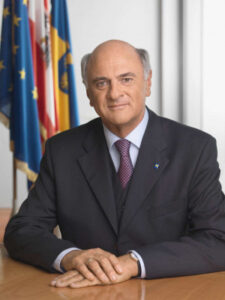
Welcome Note from LH Dr. Erwin Pröll
Eintauchen in die Welt der Europäischen Union
Europa ist unsere Heimat. Wir leben auf einem Kontinent der Freiheit, des Friedens und des Wohlstands. Doch das, was für viele von uns heute als so selbstverständlich gilt, ist es keineswegs. Vor über 20 Jahren ist Österreich der Europäischen Union beigetreten. Seither hat sich das Gesicht Europas jedoch deutlich verändert: Das Europa der 15 Mitgliedstaaten von seinerzeit ist zum Europa der 28 Mitgliedstaaten geworden. War Österreich damals noch eine Region am Rande der Europäischen Union, befindet sie sich heute in dessen Herzen.
Als Landeshauptmann von Niederösterreich freue ich mich, Sie hier im Herzen Europas begrüßen zu dürfen. Es ist dies die 15. Nationale Sitzung des Model European Parliament Austria und es ist das zweite Mal nach 2009, dass Niederösterreich mit dem Stift Klosterneuburg, dem Bundesgymnasium/Bundesrealgymnasium Klosterneuburg sowie dem NÖ Landhaus in St. Pölten dafür als Austragungsort fungieren darf. Mit dieser Tagung leistet das Model European Parliament (MEP) einen wichtigen Beitrag, der Jugend einen Einblick in den Prozess der europäischen Integration zu geben und schafft ein Bewusstsein für europäische Bürgerschaft. Es werden Sitzungen des Europäischen Parlaments simuliert und damit Jugendlichen die Möglichkeit gegeben, sich mit aktuellen europäischen Themen auseinanderzusetzen.
Die Jugend ist unsere Zukunft und die Zukunft liegt in Europa. Ich finde es daher sehr wichtig, dass sich junge Menschen bereits frühzeitig mit Europa und den Chancen und Möglichkeiten, die sich ihnen dadurch bieten, auseinanderzusetzen. Gerade junge Menschen erleben tagtäglich, welche Freiheit Europa ihnen bietet, indem sie sich innerhalb des Kontinents frei bewegen können — überall leben, arbeiten, studieren zu dürfen. Die Vielfalt der Sprachen und Kulturen innerhalb Europas ist nicht etwas, das die Menschen teilt, sondern es soll diese in ihrer Art und Weise zu leben und zu denken bereichern. In diesem Sinne wünsche ich Ihnen allen eine schöne Zeit in Niederösterreich und dass Sie mit vielen neuen Inputs wieder nach Hause kehren.
Dr. Erwin Pröll

Welcome Note from MdEP Mag. Ulrike Lunacek, Vice President of thee European Parliament
Liebe Europäische Jungparlamentarierinnen und Jungparlamentarier,
„Die dort in Brüssel!“ – das kennen wir auch in Österreich: Wie oft wird hier nicht über „die dort in Wien!“ geklagt. Doch in Österreich ist klar, dass Wien dazugehört, dass wir alle gemeinsam Österreich sind. In der EU ist das leider noch nicht so: Da ist Brüssel immer noch „Ausland“ – obwohl wir doch alle zusammen die EU sind: Wir leben in der EU, und unser Leben wird zu einem großen Teil von in der EU beschlossenen Gesetzen bestimmt. Aber es gibt auch viel Kritik an „der EU“ – einiges davon stimmt, aber lange nicht alles. Mangelhafte Information führt oft zu einer ablehnenden Einstellung gegenüber der Union.
Angesichts der großen aktuellen Herausforderungen, vor denen Europa steht, kommt das diesjährige “Model European Parliament Austria” wieder einmal gerade richtig. Ich finde es großartig, dass MEP Austria heuer bereits zur 15. Sitzung einlädt und in jungen Menschen aus ganz Österreich das Interesse an Europa weckt sowie zur aktiven Teilnahme am demokratischen Prozess in Europa aufruft.
Die Schwerpunktthemen in den einzelnen Komitees dieser Sitzung behandeln zentrale Zukunftsthemen: EU-Asylpolitik, Integration, Jugendbeschäftigung, Geschlechtergerechtigkeit, Datenschutz … Für alle diese Themen ist mehr Europa nicht das Problem, sondern nur mehr Europa wird für alle in diesen Bereichen auftretenden Fragen effektive Lösungen anbieten können.
In diesem Sinn wünsche ich allen TeilnehmerInnen eine anregende und konstruktive Debatte – erfüllen Sie unser Europa mit demokratischem Leben und bereichern Sie die Diskussion mit Ihren Beiträgen! Bei den VeranstalterInnen bedanke ich mich für die Einladung und diese tolle Initiative und wünsche viel Erfolg!

Welcome Note from MEP Mag. Othmar Karas
Liebe Europäische Jungparlamentarierinnen und Jungparlamentarier,
Europa sind nicht „die dort in Brüssel“, sondern wir alle. Europa braucht Beteiligung, Visionen und Begeisterung.
Europa gelingt nur dann, wenn wir uns alle dafür einsetzen. Der europäische Integrationsprozess muss von den Bürgerinnen und Bürgern und vor allem der Jugend aktiv mitgetragen werden. Das Model European Parliament trägt maßgeblich dazu bei. Durch die Möglichkeit sich im Rahmen der Simulation selbst in eine aktive Rolle des europäischen Integrationsprozesses hineinzudenken, wird Interesse, Verständnis und das Bewusstsein für die Europäische Union gestärkt.
Durch Auslandserfahrung, Mobilität und sprachliche Kompetenzen wachsen die Jobchancen junger Menschen nachweislich und markant. Daher bin ich der Meinung, dass jeder Schüler und jede Schülerin mindestens einmal die EU-Institutionen in Brüssel oder Straßburg besucht haben sollte, um Bewusstsein für unsere europäische Identität zu schaffen. Seitens der Europäischen Union werden durch die Programme „Erasmus“ für Studenten, „Comenius“ für Schüler, „Leonardo da Vinci“ für Lehrlinge, „Grundtvig“ für Erwachsenenbildung, sowie durch andere Fördermöglichkeiten für Jugend und Sport europäische Möglichkeiten für Lernende geboten. Diese Programme sind ein gewaltiger Erfolg, der nur durch die Entschlossenheit des Europäischen Parlaments realisiert werden konnte.
Europa gibt Jugendlichen ungeahnte Chancen für eine eigenverantwortliche Lebensgestaltung. Für unsere freiheitlich-demokratische Grundordnung ist eigenverantwortliches Handeln und die Bereitschaft zur Übernahme von Verantwortung für die Gemeinschaft unerlässlich. Das Engagement der Teilnehmer des Model European Parliament ist ein Schritt in diese Richtung.
Mag. Othmar Karas, Abgeordneter zum Europäischen Parlament
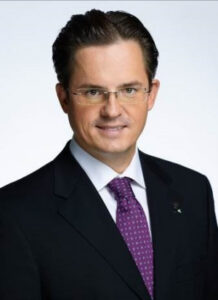
Mag. Stefan Schmuckenschlager
© charakter.photos/Philipp Monihart
Welcome Note from Mayor Mag. Stefan Schmuckenschlager
Klosterneuburg ist reich an Kultur und Tradition. Die Babenbergerstadt ist aber auch die drittgrößte Stadt Niederösterreichs. Sie liegt direkt am Donaustrom, der im Herzen Europas seit Jahrtausenden die Menschen und Völker verbindet. Europa prägt heute wie nie zuvor unsere Identität und steht für Einigkeit und grenzübergreifendes Denken. Diese Einigkeit haben unsere Vorfahren hart erkämpft, viele Kriege mussten überwunden werden. Gerade für Österreich war es ein weiter Weg. Umso schöner ist es, wenn sich junge Menschen für unser modernes Europa interessieren, es zu schätzen wissen und mit dem Gedanken eines vereinten, friedlichen Kontinents groß werden.
Das Nationale Model European Parliament Austria bringt solche jungen Menschen aus ganz Österreich zusammen. Es freut mich, dass Klosterneuburg eine der beiden Gastgeberstädte sein darf. Dies ist nicht nur bemerkenswert, da es Lebensmittelpunkt und Wirkungsstätte des Heiligen Leopold, Landespatron und Friedensstifter, war. Klosterneuburg ist auch seit über 25 Jahren Stadt der Völkerverständigung.
Dieser Ort der Verständigung, der stets am Puls der Europäischen Geschichte gelegen hat, könnte für das Model European Parliament nicht passender gewählt sein. Ich heiße die jungen Europäer herzlich willkommen und wünsche ihnen viel Erfolg dabei, an der Idee eines geeinten Kontinents aktiv mitzuarbeiten – und damit für eine Zukunft in Frieden und in Sicherheit.
Mag. Stefan Schmuckenschlager, Bürgermeister der Stadt Klosterneuburg
Unter dem Ehrenschutz des LH Dr. Erwin Pröll
Klosterneuburg 21. – 24. 01. 2016
Do 21. Januar
abends (gegen 20:00) Ankunft der Delegierten und Betreuer am Bhf. Klosterneuburg Kierling – Unterbringung bei Gastfamilien
Fr 22. Januar
08:00 Eintreffen der Delegierten
09:00 – 09:45 Eröffnung im Stift Klosterneuburg (Augustinussaal, Tel.: +43- 2243/411-253)
Imogen Bharucha und Antonia Straka:
J. Offenbach, Duo für zwei Celli op. 49, Allegro Moderato
Begrüßung:
Hw. H. Tassilo Dominik Lorenz, CanReg
Chorherrenstift Klosterneuburg
Dir. Mag. Robert Donner
Direktor BG/BRG Klosterneuburg
Mag. Stefan Schmuckenschlager
Bürgermeister von Klosterneuburg
Landesrätin Mag. Barbara Schwarz
in Vertretung von Landeshauptmann Dr. Erwin Pröll
Einleitende Worte:
Presidents of the National MEP Assembly
Lorenz Obermann und Darius Djawadi (BG/BRG Int. School Klosterneuburg)
Smaranda Vedrasco und Saam Mahmoodian (Theres. Akademie Wien)
Lukas Beckerhinn, former MEP delegate
Oxford University, Orin College
Mag. Gottfried Oehl
MEP Austria Coordinator
10:00 – 11:00 Impulsreferat und Diskussion:
Europäische Union: Herausforderung Jugend
MEP Mag. Othmar Karas, M.B.L.-HSG
Vizepräsident des Europäischen Parlaments a. D.
11:15 – 12:00 Opening Ceremony; Vorstellen der Bundesländer Delegationen
12:15 – 13:00 Mittagessen Stiftskeller, anschl. Stadtbesichtigung und Gedenkminute am Europa Platz Richard Coudenhove-Kalergi
13:45 – 16:15 Komiteetreffen (BG/BRG Klosterneuburg, Buchberggasse 31, A-3400 Klosterneuburg,Tel: +43-(0)2243-32155)
16:45 – 18:45 Teambuilding: Atelier Stift Klosterneuburg (Kreation eines Flaschenetiketts MEP), alternierend Führung im Stift
19:15 – 21:45 Kulturabend – Abendessen beim Heurigen (Agnesstraße 46, 3400 Klosterneuburg, tel.: 02243 37335) mit “Die Latawagl Musi” (Mag. Andreas Lummerstorfer, Erwin Adamowicz, Andrea Szlezak)
22:00 Gastfamilien
Sa 23. Januar
08:00 – 09:45 Komiteetreffen (BG/BRG Klosterneuburg, Buchberggasse 31, Tel: +43-(0)2243-32155)
10:30 – 12:15 Eröffnung im Stift Klosterneuburg (Augustinussaal)
Begrüßung:
Hw. H. Tassilo Dominik Lorenz, CanReg
Chorherrenstift Klosterneuburg
Presidents of the National MEP Assembly
Lorenz Obermann und Darius Djawadi (BRG Klosterneuburg)
Smaranda Vedrasco und Saam Mahmoodian (Theres. Akademie Wien)
10:45 – 12:15 Impulsreferat und Diskussion:
EU – Quo vadis?
Mag. Ulrike Lunacek
Vize Präsidentin des Europäischen Parlaments
Delegationsleiterin der österr. Grünen im europäischen Parlament
Fraktion der Grünen / Freie Europäische Allianz
12:45 – 13:45 Mittagessen: Stiftskeller
14:15 – 16:45 Komiteetreffen (BG/BRG Klosterneuburg)
16:45 – 17:15 Jause: Niederösterreich stellt sich vor
17:15 – 18:15 Delegationsmeeting
18:15 – 18:45 Lobbying
19:15 – 22:30 Babenberger Business Ball (Rathausplatz 5, 3400 Klosterneuburg)
22:30 Gastfamilie
So 24. Jaunar
07:00 Abfahrt nach St. Pölten (vom Happyland bei Bahnhof Klosterneuburg Kierling)
07:45 Eintreffen der Delegierten
08:30 – 09:00 Opening ceremony
Landhaus, Landtagsaal (Landhausplatz 1, 3109 St.Pölten, Tel.: 02742/9005-0)
Begrüßung: Ing. Hans Penz
Präsident des Niederösterreichischen Landtags
in Vertretung von Landeshauptmann Dr. Erwin Pröll
Sprecher:
Mag. Georg Pfeifer
Leiter des Informationsbüros des Europäischen Parlaments
09:00 – 13:00 Plenary Session
13:00 – 13:30 Closing Ceremony
Sprecher:
Presidents of the National MEP Assembly
Lorenz Obermann und Darius Djawadi (BRG Klosterneuburg)
Smaranda Vedrasco und Saam Mahmoodian (Theres. Akademie Wien)
Mag. Gottfried Oehl,
MEP Austria
im Anschluss lädt Landeshauptmann Dr. Erwin Pröll zum Empfang
15:15 Abfahrt der Delegationen ab St. Pölten Bhf.
1 Committee on Civil Liberties, Justice and Home Affairs 1
Given the rising number of those fleeing conflicts worldwide, what coherent direction should the EU’s refugee and asylum policy pursue to account for burden-sharing amongst Member States whilst upholding humanitarian principles?
Given the rising number of those fleeing conflicts worldwide, what coherent direction should the EU’s refugee and asylum policy pursue to account for burden-sharing amongst Member States whilst upholding humanitarian principles?
Honorable delegates of the Committee on Civil Liberties, Justice and Home Affairs 1,
Let me at first congratulate you on having the opportunity to represent your federal state in this January’s National MEP Session in Klosterneuburg.
Right at this moment, the refugee crisis is clearly one of the most pressing issues the EU has to deal with. Therefore, this topic has been chosen for a Committee issue at the National MEP Session. Here, you will have the opportunity to discuss, debate, cooperate, and create a resolution on how our community of states should deal with this problem.
Enclosed, you will find a few links that might prove helpful to you during preparation. I would like to emphasize the need of being well prepared, as it will greatly influence our work. Without previously acquired knowledge of our issue, you will not be able to actively participate in the committee meetings. However, it is not necessary for you to learn any facts and figures by heart as, upon being asked to do so by a member of the chairing team, you may use your laptop for research during the committee meetings.
Your preparation does not need to be limited to the links provided. Be encouraged to conduct research independently and, most importantly, form your own opinion and ideas on the issue. While doing this, be sure to check the objectivity of your sources. Also, remember to bear in mind the viewpoint of your own county while collecting ideas.
MEP work is done at the assumption of an unlimited budget. Therefore, you do not need to worry about costs while collecting ideas.
We expect a one-page summary about the issue given above, which is to be sent to mep@emilnusser.com by 7th January 2016.
An introduction video: http://www.mepeurope.eu/model-european-parliament-norwich-2013/
As your Committee President, together with my Co CP and CP Sec I will be chairing our discussions and direct you towards drafting a resolution. We will show you how it is done but cannot monitor your content input. Therefore it is necessary for all of you to do some preparation using the links and tips provided below. As you will all maybe be interested in representing Austria in the upcoming MEP sessions in Budapest, Sofia and Copenhagen we will be evaluating and grading your performance in the committee as well as in the General Assembly.
In order to make things easier for you, we have attached a couple of links which can help you with your research. You should inform yourself about current statistics, problems, causes and effects of youth unemployment and an aging society.
Three things to keep in mind:
- The MEP works under the assumption of an unlimited budget, thus financial issues should not be taken into consideration.
- The MEP attempts to remain politically independent as an institution. Hence, political campaigns should not be part of your preparation.
- Bear in mind that, if you want to make arguments or claims, you need proof and evidence. While researching you should not forget that some sources are more credible than others.
Lastly, we are all very much looking forward to meeting and working with you in January!
Kind regards and best wishes,
Your chairing team
Laetitia Reinthaller (CP), Emma Heiling (Co CP), Emil Nusser (CP Sec)
Livian Enachescu (CIE), Larissa Baku (SMO)
Links
https://www.youtube.com/watch?v=RvOnXh3NN9w
http://www.bbc.com/news/world-europe-34131911
http://www.unicef.org/emergencies/index_85510.html
https://www.hrw.org/report/2015/11/16/europes-refugee-crisis/agenda-action
https://www.newscientist.com/article/mg22730383-800-why-welcoming-more-refugees-makes-economic-sense-for-europe/
http://ec.europa.eu/echo/refugee-crisis_en
http://eur-lex.europa.eu/LexUriServ.do?uri=OJ:L:2013:180:0031:0059:EN:PDF
http://ceciliawikstrom.eu/en/politics/migration-and-asylum/the-dublin-iii-regulation/
https://www.youtube.com/watch?v=umqvYhb3wf4
2015 UNHCR subregional operations profile – Northern, Western, Central and Southern Europe
European Union predicts 3 million more migrants by end of next year (Washington Post, 5/11/2015)
Common asylum system at a turning point: Refugees caught in Europe’s solidarity crisis
2 Committee on Employment and Social Affairs
How should Europe cope with an ageing society and its consequent effects on the labour market? Which measures should the EU take to rejuvenate society, ensure employability of the youth and to keep the European workforce globally competitive?
How should Europe cope with an ageing society and its consequent effects on the labour market? Which measures should the EU take to rejuvenate society, ensure employability of the youth and keep the European workforce globally competitive?
Honorable delegates of the Committee on Employment & Social Affairs,
My name is Jakob Dunshirn and I will be your committee president for the upcoming National MEP Session in Lower Austria. I greatly look forward to working together with every single one of you.
As your Committee President, together with my Co CP and CP Sec I will be chairing our discussions and direct you towards drafting a resolution. We will show you how it is done but cannot monitor your content input. Therefore it is necessary for all of you to do some preparation using the links and tips provided below. As you will all maybe be interested in representing Austria in the upcoming MEP sessions in Budapest, Sofia and Copenhagen we will be evaluating and grading your performance in the committee as well as in the General Assembly.
In order to make things easier for you, we have attached a couple of links which can help you with your research. You should inform yourself about current statistics, problems, causes and effects of youth unemployment and an aging society.
Three things to keep in mind:
- The MEP works under the assumption of an unlimited budget, thus financial issues should not be taken into consideration.
- The MEP attempts to remain politically independent as an institution. Hence, political campaigns should not be part of your preparation.
- Bear in mind that, if you want to make arguments or claims, you need proof and evidence. While researching you should not forget that some sources are more credible than others.
I would like to ask all of you to send me a summary of the research you have made, including two ways to solve the Committee Issue (about 350 words) by Friday, January 15th. I strongly advise you to take preparation seriously. Also, if you have any further questions about the MEP or preparation, feel free to contact me or the other members of the committee chairing team. In case you have any questions regarding the issue itself, I would suggest contacting our CIE (Committee Issue Expert) Thomas Sun. The whole team is very much looking forward to meeting you in January.
Kind regards and best wishes, Your Committee Chairing Team.
Committee President, Jakob Dunshirn (jakob.dunshirn@gmail.com)
Co. Committee President, Katherina Geilersdorfer (katharina.geilersdorfer@chello.at)
Committee President Secretary, Attila Kaplan (attkap@gmail.com)
Student Media Officer, Paul Eichmüller paul.eichmueller@aon.at
CIE: Thomas Sun: sun.thomas98@gmail.com
Research links
Youth Unemployment
http://epp.eurostat.ec.europa.eu/statistics_explained/index.php/Unemployment_statistics
http://www.theguardian.com/commentisfree/2013/jul/01/youth-unemployment-not-age-lack-of-skills
http://www.economist.com/news/international/21576657-around-world-almost-300m-15-24-year-olds-are-not-working-what-has-caused
http://www.huffingtonpost.com/2013/09/27/youth-unemployment-crisis_n_4004693.html
http://www.businessinsider.com/youth-unemployment-could-tear-europe-apart-warns-world-economic-forum-2013-11
http://www.theatlantic.com/business/archive/2013/11/the-youth-unemployment-crisis-might-not-be-a-crisis/281802/
https://www.youtube.com/watch?v=lAMXEd1ceJ8&app=desktop
http://www.bloomberg.com/bw/articles/2014-11-06/three-ways-europe-could-solve-its-youth-unemployment-crisis
http://www.euractiv.com/sections/youth-unemployment/economist-there-role-eu-policy-overeducation-among-young-people-317803
http://www.euractiv.com/sections/youth-unemployment/study-highlights-different-drivers-youth-unemployment-317937
Ageing Society
http://www.mckinsey.com/insights/europe/the_graying_of_europe
http://www.economist.com/news/finance-and-economics/21570752-growth-will-suffer-workers-dwindle-working-age-shift
http://epp.eurostat.ec.europa.eu/statistics_explained/index.php/Population_structure_and_ageing
http://www.reuters.com/article/2013/04/24/us-europe-economy-demographics-insight-idUSBRE93N09B20130424
http://www.healthyageing.eu/initiatives/european-policies-and-initiatives
http://ec.europa.eu/health/ageing/policy/index_en.htm
http://www.ft.com/cms/s/0/f5378e04-27ac-11e3-ae16-00144feab7de.html#axzz2tb9IYdcw
http://www.worldbank.org/en/news/feature/2013/01/17/the-eu-11-in-an-aging-europe
http://www.nber.org/papers/w12736.pdf
http://www.21stcenturychallenges.org/focus/britains-greying-population/
http://seniorliving.about.com/od/babyboomers/a/aging_pop_tips.htm
http://www.oecdobserver.org/news/archivestory.php/aid/741/Ageing_populations:_How_the_Dutch_cope.html
http://www.ncbi.nlm.nih.gov/pmc/articles/PMC2810516/?iframe=true&width=100%25&height=100%25&_escaped_fragment_=po=8.33333
https://www.youtube.com/watch?v=DYqflhHLAGM&app=desktop
http://www.euractiv.com/socialeurope/eu-search-retirement-age-formula-news-510897
3 Committee on Women’s Rights and Gender Equality
With slow progress in achieving gender parity across Europe in both political positions and the private sector, what is the role of women in perpetuating inequality in the workplace? To what extent should the EU and Member States take more action in order to unlock the full potential of Europe’s female labour force?
With slow progress in achieving gender parity across Europe in both political positions and the private sector, what is the role of women in perpetuating inequality in the workplace? To what extent should the EU and Member States take more action in order to unlock the full potential of Europe’s female labour force?
Distinguished delegates of the Committee on Women´s Rights and Gender Equality,
Let us first congratulate you on being chosen to represent your federal state in the national MEP session in January 2016. My name is Catherina Schwaiger and I will be your Committee President during the National MEP session in Klosterneuburg.
It will be the task of Emilie Berger (Co CP) Maximilian Knaser (CP Sec.) and me to chair the Committee Meetings and to help you drafting the resolution. In addition, two CIEs (Committee Issue Experts) (Natalie Komissarova, Antonia Frey) who will provide background information on our topic, will support you.
A short overview on the procedure of the Model European Parliament for all of you who have never taken part in an MEP session: (see also http://www.mepeurope.eu/model-european-parliament-norwich-2013/)
During the Committee Meetings, we are going to work on the so-called introductive clauses (IC´s) and the operative clauses (OC´s). By formulating IC´s, we will outline and point out the actual problems of our topic. Afterwards, we will have to set up an approach to solving these problems in terms of writing down OC´s. Since the OC´s can be considered as the most important part of the resolution and the overall time available for the Committee Meetings is little, we should not spend too much time on the IC´s. I therefore advise you all to prepare and to sum up the problems of our topic in advance in order to proceed quickly and more effectively. After having finished the resolution itself, we will choose members of the committee to deliver several speeches in the General Assembly, such as the opening speech, the speech against the amendment and the speech in favour of the resolution. But you will certainly get familiar with how the Model European Parliament works very soon.
At this point we would like to draw your attention to the importance of the preparation work, which can be considered as the foundation of our meetings.Without any previous knowledge, you will not be able to actively take part in the discussions. Therefore, we would like you to write a summary on our topic by January 10th and send it to us via email. Included should be a description of the current situation for women as well as possible solutions for occurring issues. Also, try to answer the given question of our committee. (see below) Please take this work seriously, since it will also have an impact on your evaluations. The more prepared you are, the more likely it is to fulfil our expectations. We want you to have a broad knowledge of the topic, as well as to participate in the discussions and do the given homework, thus achieving a solid resolution.
As your Committee President, together with my Co CP and CP Sec I will be chairing our discussions and direct you towards drafting a resolution. We will show you how it is done but cannot monitor your content input. Therefore it is necessary for all of you to do some preparation using the links and tips provided below. As you will all maybe be interested in representing Austria in the upcoming MEP sessions in Budapest, Sofia and Copenhagen we will be evaluating and grading your performance in the committee as well as in the General Assembly.
In order to make things easier for you, we have attached a couple of links which can help you with your research. You should inform yourself about current statistics, problems, causes and effects of youth unemployment and an aging society.
Three things to keep in mind:
- The MEP works under the assumption of an unlimited budget, thus financial issues should not be taken into consideration.
- The MEP attempts to remain politically independent as an institution. Hence, political campaigns should not be part of your preparation.
- Bear in mind that, if you want to make arguments or claims, you need proof and evidence. While researching you should not forget that some sources are more credible than others.
In order to simplify the communication between all of us, please also send us your phone numbers and download the App WhatsApp in case you are not already using it, as we would like to establish a group chat in the near future.
We wish you all the best for your preparation and are already looking forward to working with you.
Please do not hesitate to contact us on case of any questions!
Best regards,
Catherina Schwaiger
Contact:
catherina.schwaiger@gmx.at
emmiberger@hotmail.com
maximilian.knaser@chello.at
nathalie.komissarova@gmail.com – (CIE)
mimzi@gmx.at – (CIE)
preparation links
- Overview of sites and links about gender equality:
- The European´s Commission Strategy for equality between women and men
- Roadmap for Equality between women and men (2006 – 2010)
- Gender pay gap
- Gender Segregation in the Labour Market and Education
- Collection of links to improve the women´s situation at the workplace
- Results of public consultation on Equality between men and women in the EU
- Roadmap for improving work-life balance in working families
- Gender equality fresh start background paper
- Maternity Leave
- Parental Leave report
- Supporting female entrepreneurs
- Good Practice for women´s entrepreneurs
- http://ec.europa.eu/justice/gender-equality/files/exchange_of_good_practice_uk/141112_summary_report_uk_final_en.pdf
- Report on the future of gender equality
- External factors that represent hurdles to European female entrepreneurship (“Entwurf eines Berichts”)
- The EU`s work in Gender equality worldwide
- No development without women’s empowerment
- Gender, Women and Democracy
- Gender Balance in decision-making positions
Video Material
4 Committee on Civil Liberties, Justice and Home Affairs 2
The question of safe internet use:
How can the EU ensure a safer Internet for its youth? What measures can be taken to reduce the impact of cyber-bullying, internet grooming and unregulated social networking sites on the life of young people without violating the right to free speech and freedom of information?
The question of safe Internet use:
How can the EU ensure a safer Internet for its youth? What measures can be taken to reduce the impact of cyber-bullying, Internet grooming and unregulated social networking sites on the life of young people without violating the right to free speech and freedom of information?
Honorable Delegates,
My name is Ioana Laura Crisan and I will be your Committee President in the National MEP session 2016! I am eagerly looking forward to meeting all of you!
The majority of you will be new to the Model European Parliament, but please do not worry: Most delegates have no previous experience and you are here to learn together. You will meet amazing people from all around Austria and create bonds that will truly last. While the MEP is about working hard, do not forget to enjoy your experience, as it is a thrilling one!
This research module will contain a brief summary of the information you will need, if you want to succeed in the MEP. It is crucial for you to be well prepared and to know your topic extremely well. At the end of the session, we will grade you according to your participation during the debates and assembly meeting. Without preparation, you will simply not be able to attend and contribute to the discussion. To make sure that you gain all the necessary knowledge, you will be expected to send me summaries and other essays by the deadlines that we have set. All preparation work is listed below.
A bit of advice:
It is vital that you have a good grasp of the topic of our committee. During debates, my colleagues and I will only be able to guide your discussion and interfere when we think that the information you have included is wrong/outdated. It will be up to YOU and your fellow delegates to draft the resolution and to make sure that it answers the question.
Another important thing is that you know what terms and expressions like Committee President, Resolution, General Assembly etc. mean, so that we can be as efficient as possible. You will hear these words frequently over the following period of time, so you need to know what they mean. You can find all this information on the home page of the MEP. (www.mepeurope.eu – education) You might find it helpful to make some sort of vocab list. Do what works best for you.
The language of the MEP is ENGLISH. You can speak whatever language you’d like in our free time, but during debates you have to speak English.
Now you must understand the principle of MEP. You will be writing a resolution for the EU/Austria. This does not mean that you shouldn’t research information about other countries as well. It is important that you see this problem from different perspective. Many other states (f.e. the USA) are the origin of various sites that Europeans use. The problem with Internet safety is quite a delicate one and affects the entire world. However, you must be careful when formulation the resolution, the regulations you want to impose should mostly concern the EU.
MONEY IS NOT A PROBLEM. Delegates often forget this crucial rule of the MEP. They’ll start asking money related questions in the General Assembly. The idea of MEP is that you have unlimited access to money. So you don’t have to worry about how something will be funded.
As your Committee President, together with my Co CP and CP Sec I will be chairing our discussions and direct you towards drafting a resolution. We will show you how it is done but cannot monitor your content input. Therefore it is necessary for all of you to do some preparation using the links and tips provided below. As you will all maybe be interested in representing Austria in the upcoming MEP sessions in Budapest, Sofia and Copenhagen we will be evaluating and grading your performance in the committee as well as in the General Assembly.
In order to make things easier for you, we have attached a couple of links which can help you with your research. You should inform yourself about current statistics, problems, causes and effects of youth unemployment and an aging society.
Three things to keep in mind:
- The MEP works under the assumption of an unlimited budget, thus financial issues should not be taken into consideration.
- The MEP attempts to remain politically independent as an institution. Hence, political campaigns should not be part of your preparation.
- Bear in mind that, if you want to make arguments or claims, you need proof and evidence. While researching you should not forget that some sources are more credible than others.
Lastly, you must always remember that YOU have to form YOUR OWN OPINION. The links and articles we have sent you are only supposed to make you understand all that your topic is about. They are not there to impose on you anything. Also, these links only represent a part of the information you need. Feel free to research anything you want.
CP: Ioana Crisan
CoCP: Shayan Kohler
CPSec: Anja Weinberger
CIE: Mia Hermann
preparation links
http://ec.europa.eu/digital-agenda/en/self-regulation-better-internet-kids
ATTENTION OLD DOCUMENT 2008
http://ec.europa.eu/public_opinion/flash/fl_248_sum_en.pdf
Really important: law of freedom of information PDF to download (maybe get in touch with each other, get to know this stuff well so you know what laws your resolution must take into consideration, as it cannot contradict any existing legislation):
https://www.google.at/url?sa=t&rct=j&q=&esrc=s&source=web&cd=3&ved=0ahUKEwj13YfDrNfJAhXJRhQKHRjZBhwQFggsMAI&url=https%3A%2F%2Feutopialaw.files.wordpress.com%2F2011%2F11%2Feu-law-and-freedom-of-information.docx&usg=AFQjCNEBDYP9N64ypndlM-e8wSnZCfHa7A&sig2=2X8h11sHOJTlsCjfRsT4cQ
Amazing content, also the view of a lawyer on the topic, might be useful as to what limitations the EU law encounters in its fight against cyber bullying
http://deletecyberbullying.eu
Section on EU Law (if you want you can take a look at UK law and international law — but BEWARE: you are suppose to create a resolution for THE EU AND NOT THE WHOLE WORLD/OTHER ORGANISATIONS so cyber bullying in the USA is NOT interesting for you) might be interesting:
https://www.cybersmile.org/advice-help/category/cyberbullying-and-the-law
https://ec.europa.eu/digital-agenda/en/cybersecurity
https://ec.europa.eu/digital-agenda/en/online-privacy
https://www.eba.europa.eu/regulation-and-policy/consumer-protection-and-financial-innovation/guidelines-on-the-security-of-internet-payments
https://ec.europa.eu/digital-agenda/en/broadband-strategy-policy
http://www.eubusiness.com/topics/internet
http://users.ugent.be/~bfdwever/owk1011/docwiki3/Longitudinal_study_of_safe_Internet_use_of_young_children.pdf
http://www.lse.ac.uk/media@lse/research/EUKidsOnline/EU%20Kids%20I%20%282006-9%29/EU%20Kids%20Online%20I%20Reports/WP3NationalReportAustria.pdf
https://www.digitales.oesterreich.gv.at/site/6534/default.aspx
https://www.bka.gv.at/site/7902/default.aspx
http://europa.eu/epic/news/2014/20140805-cyberbullying-harm-european-children_en.htm
http://www.theguardian.com/society/2015/sep/22/cyberbullying-teenagers-worse-than-drug-abuse-says-report
http://www.cyberpsychology.eu/view.php?cisloclanku=2011121901&article=4
http://www.europeanonlinegroomingproject.com/media/2080/eogp-literature-review.pdf
http://stakeholders.ofcom.org.uk/binaries/internet/internet-safety-measures.pdf
http://eacea.ec.europa.eu/education/eurydice/documents/thematic_reports/121EN.pdf
https://ec.europa.eu/digital-agenda/sites/digital-agenda/files/digital_single_market_factsheet_final_20150504.pdf
http://users.ugent.be/~mvalcke/CV/unsafe_2011.pdf
The psychological aspect of cyber bullying might be interesting for you:
http://pb.rcpsych.org/content/37/5/167
What are the limits of freedom of speech?
http://www.debatingeurope.eu/2015/06/04/hate-speech/#.Vm2mNV_mWJI
For your better understanding of the deep web:
http://www.slate.com/blogs/quora/2015/08/19/deep_web_what_is_it_and_how_do_you_access_it.html
Many organizations like the ISIS use the Internet to recruit young people, which is in no way beneficial.
http://www.bbc.co.uk/newsbeat/article/31574846/how-islamic-state-extremists-use-social-media-to-recruit


