


nMEP Niederösterreich 2024
January 18, 2024-January 21, 2024
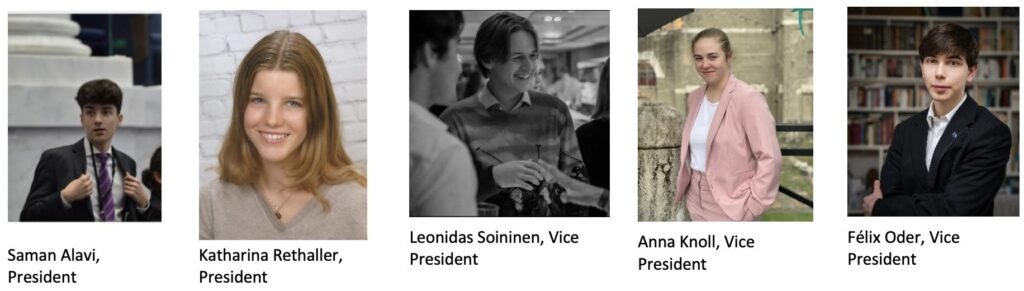
Letter from the presidents
Honourable Delegates, Committee Presidents, and CIEs,
We, the presidency, are delighted to welcome you to the 23rd national MEP session in Klosterneuburg, Austria. From the 18th to the 21st of January, you will get to experience some of Lower Austria’s finest institutions, such as the Institute of Science and Technology Austria (ISTA), the Klosterneuburg Abbey and the Landhaus in St. Pölten, all of which have extended their hospitality and granted us the opportunity to get to know their best assets. In our town, which is the 3rd largest in Lower Austria, we have a variety of rich traditions, ranging from the most extraordinary wines from the abbey to our annual festivities for our patron, Saint Leopold. Every year, around the 15th of November, people from Klosterneuburg and its surroundings gather to drink punch, hop on merry-go-rounds and slide down the 1000 litre barrel to make a wish. Maybe you will get the chance to join us and celebrate with us next year.
Our honourable speakers stem from both the political and scientific field and will shed light on the potential role of artificial intelligence in the world of politics. This unprecedented focus on some of the most pressing issues in the 21st century is part of the reason why this session will be extraordinary and memorable. We are proud to announce that leading experts, Professor Dr. Gaia Novarino, Prof. Dr. Tim Vogels and Prof. Dr. Martin Selmayr will share their insights into the topic. Furthermore, two of the most prominent figures of Lower Austria’s political landscape, Johanna Mikl-Leitner, the governor of Lower Austria and Mag. Stefan Schmuckenschlager, the Mayor of Klosterneuburg, have shown the courtesy of welcoming us in the opening ceremony. As a representative of the Klosterneuburg Abbey, the new provost will greet us as well.
Dear delegates, within the course of three days, you will learn about the legislative structures of the European Union and the process that goes along with creating a resolution. But most importantly, you will learn about yourself. What role do you want to take on during the session? You have been given the chance to participate in committee discussions, hold fruitful debates and give speeches. Our advice: Use it to the best of your abilities. Use it to discover who you are. You may find out that you can keep listeners on the edge of their seats with your speech. Or that you are a team player in the committee meetings, working towards a common goal. Whatever it is, embrace it and capitalize on your strengths. Naturally, it will not always be easy to navigate through your committee work. We advise you to step out of your comfort zone and keep an open mind. Compromise and tolerance are key components of a successful MEP session. Keeping this in mind, you will get the most out of it.
Let’s work together and make this session the very best!
Good luck,
Your presidency
Programme
See Downloads section
Committees & Issues
1 Committee on Culture and Education (CULT/AIDA)
The question of implementing Artificial Intelligence in Education
With the large strides AI technology is taking, the question of its implementation in the field of education arises. How can the EU guarantee the safe, yet effective use of this cutting-edge technology to enhance educational methods? What measures must be taken to prevent the misapplication of AI in education?
2 Industry, Research and Energy (ITRE)
The question of the EU as a manufacturer of electromobile innovation
The EU has outlined an ambitious timeplan to move away from conventional combustion engine vehicles. How can the EU ensure a smooth but effective transition of factories and manufacturing methods in order to give incentives for sustainable change in Europe and prevent automobile manufacturers from moving production outside of the EU?
3 Committee on Internal Market and Consumer Protection (IMCO)
The question of a more stable and independent energy market
Considering the recent volatility in the world energy market, it is clear that the EU needs to find a more independent way of satisfying the ever-growing energy needs of its citizens and industries. How can this be achieved while following the EU sustainability goals? Is nuclear an option?
4 Committee on Women’s Rights and Gender Equality (FEMM)
The question of reducing gender bias and modernizing the workspace:
Professionals for Science, Technology, Engineering and Mathematics (STEM) are in great demand. Men working in traditionally male-dominated fields like STEM still greatly outnumber women. As these scientific fields become increasingly more important with regards to digitalization, development, healthcare etc. What measures should the EU take to simultaneously promote gender equality in male dominated fields and modernize the workspace? How can gender bias be reduced in the job market?
Downloads
