


nMEP Oberösterreich 2022
January 28, 2022-January 30, 2022
Letter from the presidents
Venerable Committee Chairs, Honourable Delegates, Ladies and Gentlemen,
It is a great pleasure to welcome you to the 21st national MEP session in Wels, Upper Austria. We are delighted to be hosting the 2nd digi national session from the 28th to 30th of January. Despite Covid-19 restrictions, MEP continues to ensure a vivid and animated exchange between students from all over Europe, in this case Austria and Germany.
Despite being online, this MEP session will grant you the opportunity to have thought-provoking discussions, insightful debates and meet new people, perhaps even future friends. The Model European Parliament is a truly exceptional opportunity, cherished by many current and past members.
You may not be able to currently be there, but Upper Austria truly embodies the typical Austrian landscape always seen in the media. With its vastly diverse scenery, including imposing mountain ranges and lush lakeside terrain, Upper Austria makes up a fundamental part of Austrian culture and economy. The region boasts tourist hotspots like Hallstatt, a small traditional village that attracts around one million tourists every year or the lake area Attersee, to name but a few of the countless tourist destinations frequented by so many.
Upper Austria does not just offer beautiful scenery, it continues to be a hub for innovation and industrial progress from ARS Electronica to Voest. All fields summarized under the umbrella term STEM are innovations of the future. Austria holds a lot of untapped potential and brainpower just waiting to be recognized and developed.
In these times of isolation, the importance of digitalization has been highlighted. Zoom and Teams have become crucial to our daily lives and more and more people rely on technology for daily necessities. These advancements will become ever more relevant as our world becomes more and more digital. The focus of this MEP session will be on this and how we, as a society, can draw positives from the pandemic and the growing digitalization. How will the global consequences of the virus outbreak shape our future to come?
The pandemic has created a seemingly unmendable divide in our society and it is up to all of us to bridge the gap. MEP gives us the necessary skills to reach a compromise and have fruitful debates about crucial topics which need to be tackled sooner rather than later.
We are looking forward to seeing your resolutions and wish you a valuable and exciting MEP experience.
We hope that you will enjoy this year’s national MEP session!
Your Presidency
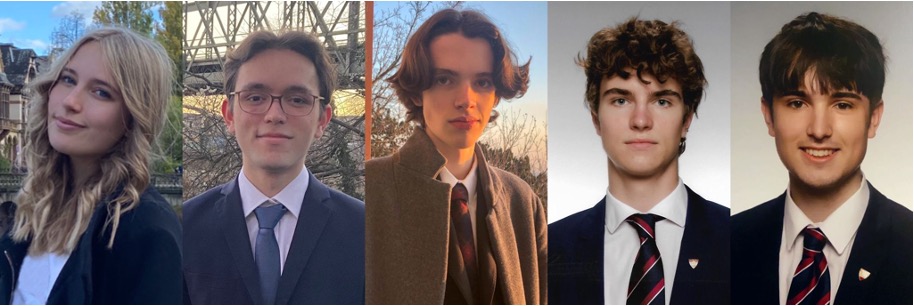
Ronja Endfellner (WRG ORG Wels), Manuel Ganja Tejera (WRG ORG Wels), Solomon Clarke-Foster (Theresianische Akademie), Laurenz Stastka (Theresianische Akademie), Benedikt Wietrzyk (Theresianische Akademie)
Welcome Videos
Othmar Karas
Begrüßung von MEP Dr. Othmar Karas, erster Vizepräsident des Europäischen Parlaments
Thomas Stelzer
Videobotschaft von Mag. Thomas Stelzer, Landeshauptmann von Oberösterreich
Max Hiegelsberger
Grußbotschaft von Max Hiegelsberger, Präsident des OÖ. Landtags
Programme
See Downloads section
Committees & Issues
1 Committee on Employment and Social Affairs (EMPL)
The question of reducing gender bias and modernizing the workspace:
Professionals for Science, Technology, Engineering and Mathematics (STEM) are in great demand. The number of men working in traditionally male-dominated fields like STEM still greatly surpasses the number of women. As these scientific fields become increasingly more important with regards to digitalization, development, healthcare etc.
What measures should be taken to simultaneously promote gender equality in male dominated fields and modernize the workspace? How can gender bias be reduced in the job market?
2 Committee on Civil Liberties, Justice and Home Affairs (LIBE)
The question of online radicalization:
Aiming at increasing engagement and interactions, recommender algorithms on social media platforms such as YouTube are pushing user towards increasingly radical content and unilateral sources of (mis)information (filter bubbles). As a result, conspiracy theories and fake news have increased in popularity. How can the EU counteract this development and promote media pluralism protecting its democracy and political institutions? What measurements should be taken to prevent
3 Committee on Transport and Tourism (TRAN)
The question of sustainable tourism in the light of COVID19 pandemic:
Travel has been restricted and nearly put to a standstill because of the pandemic. Many companies, most notably airlines, have required bail outs and people’s job security has been compromised. Despite having detrimental effects on the entire world, the pandemic reduced the negative effects on the environment created by tourism.
What steps need to be taken to guarantee job security for those employed in the tourism sector? How can the EU ensure sustainable tourism?
4 Committee on Environment, Public Health and Food Safety (ENVI)
The question of rising rates of mental illness especially among digital natives:
The COVID-19 pandemic has taken a toll on people’s mental health. Rates of mental illnesses such as Depression and Anxiety are at an all-time high, which is not only due to the COVID-19 Pandemic, lockdowns, and social isolation but also due to people ́s fast paced and often overwhelming lifestyles and social media.
How should the EU address the mental health crisis partially caused by the COVID pandemic? How does the social media usage of digital natives factor into the rising mental health issues? What steps should the EU take?
Downloads
